

Introduction
Every month, millions of people search for one thing: how to view Instagram content without being seen.
Whether you want to watch a competitor’s Stories without tipping them off, browse a public profile without an account, or simply keep your online activity private — anonymous Instagram viewers have become essential tools in 2026.
Four names dominate this space: iSnoop, Gramho, Picnob, and ItsAnony. Each one built a loyal following by promising the same thing — free, anonymous, no-login access to public Instagram content.
But which one actually delivers in 2026? Which ones have shut down, rebranded, or gone paid? And is there a better option none of them can match?
This is the most complete, honest comparison guide available — updated for 2026.
Why People Need Anonymous Instagram Viewers
Before comparing the tools, it helps to understand the real reasons people look for them.
The most common reason is simply privacy during casual browsing. Instagram’s design is intentional — it tells account owners exactly who viewed their Story. For many users, that level of visibility feels intrusive. Wanting to check a public profile quietly is not suspicious behavior — it is a normal privacy preference that Instagram’s native app does not accommodate.
Beyond casual browsing, social media marketers and researchers rely on these tools heavily. Monitoring a competitor’s content strategy without alerting them, tracking an influencer’s posting patterns before a partnership, or researching a brand’s visual identity — all of these require anonymous access to public content that Instagram itself does not provide.
There is also a growing segment of users who simply do not want an Instagram account but still need to access public content occasionally. Instagram increasingly restricts content visibility to logged-in users, pushing non-account holders toward third-party tools.
All four tools in this comparison were built to serve these exact needs. The question is which ones still do.
iSnoop — The Story-Only Viewer
iSnoop built its reputation on one specific promise: watch any public Instagram Story without appearing in the viewer list. Simple, focused, and free.
At its best, iSnoop delivered on that promise cleanly. Enter a username, get the Stories, disappear. No account needed, no digital trace left behind.
The 2026 reality is more complicated. iSnoop has been hit hard by Instagram’s ongoing API restrictions. Users in 2026 consistently report slow load times, empty results on active accounts, and captcha walls that interrupt the experience entirely. The platform also has no public information about its operators, no clear privacy policy, and zero official support channel.
What iSnoop can do remains limited even when it works — Stories and Highlights only. No Reels, no Posts, no download management, no analytics. For the full breakdown of its current reliability, features, and whether it is worth using in 2026, the complete iSnoop review covers everything you need to know before relying on it.
Bottom line on iSnoop: Functional for occasional Story viewing when it works. Unreliable as a primary tool in 2026.
Gramho — The Analytics Giant That Disappeared
Gramho was in a different category entirely from the other three tools in this comparison. It was not just a viewer — it was a full Instagram analytics platform available entirely for free.
Public profile analytics, engagement rate calculations, follower growth estimates, posting frequency data — Gramho provided all of it without requiring a login or account. For marketers and researchers, it was genuinely irreplaceable.
Then it vanished. Gramho rebranded to Gramhir, and Gramhir gradually stopped functioning as Instagram locked down API access for unauthorized third-party tools. The core viewing and analytics features that made Gramho famous are now non-functional. What remains is a shell of the original platform.
Making things worse, the void left by Gramho’s shutdown has been filled by dangerous fake clone sites using the Gramho name to attract users searching for the original tool. Many of these clones are phishing sites or malware distributors. Anyone still searching for Gramho in 2026 faces a real risk of landing on one of these fraudulent pages.
For users who specifically need the analytics component, the only current option is Inflact — the paid successor to Gramho’s commercial features — which operates on a subscription model that most casual users cannot justify.
For users who just want the anonymous viewing capabilities Gramho once provided, there are free working alternatives. The full Gramho story — what happened, why it shut down, and what actually works now — is worth reading before searching for the original tool.
Bottom line on Gramho: Gone in any meaningful sense. Searching for it in 2026 is more likely to land you on a dangerous clone site than a working tool.
Picnob — The Tool That Cannot Stop Rebranding
Picnob sits in an interesting middle position in this comparison. Unlike iSnoop’s narrow focus or Gramho’s ambitious analytics, Picnob aimed to be a complete Instagram content access tool — photos, videos, Stories, Reels, and profile pictures, all downloadable, all free.
The feature set was genuinely impressive. Picnob delivered on its download promises for public accounts more consistently than most competitors. It was fast, it covered more content types than either iSnoop or ItsAnony, and the interface was straightforward enough for non-technical users.
The problem is stability — or rather, the complete absence of it. Picnob has rebranded twice in two years. Picnob became Pixwox. Pixwox became Pixnoy. The current operational version in 2026 is Pixnoy, which delivers largely the same functionality under yet another name.
This rebranding cycle is not a minor inconvenience. Every domain change breaks existing links, invalidates saved bookmarks, and creates a window where fake clone sites flood search results using the abandoned domain name. For users who need reliable, consistent access to a tool — not one they have to re-locate every six months — this pattern is disqualifying.
Picnob also has a persistent aggressive advertising problem. Several versions have deployed pop-up redirect tactics that range from annoying to genuinely suspicious. The operators remain anonymous, with no public disclosure of who runs the platform or how user data is handled.
If you are researching whether the current Pixnoy version is safe, what Picnob’s rebranding history actually means for your privacy, and how its download capabilities compare to more stable alternatives, the detailed Picnob breakdown covers all of it with current 2026 testing results.
Bottom line on Picnob: Technically functional in its Pixnoy form. Too unstable and opaque for users who need a reliable long-term tool.
ItsAnony — The Cleanest Option With the Narrowest Scope
ItsAnony is the newest of the four tools and in many ways the most pleasant to actually use. The interface is clean and minimal. The mobile experience is noticeably better than Gramho or early versions of Picnob. The core functionality — anonymous Story and Highlight viewing — works consistently for most public accounts.
Where ItsAnony earns genuine credit is in execution quality. It does what it promises, the experience is smooth, and it does not bombard users with aggressive advertising the way some competitors do.
But the scope is seriously limited. ItsAnony covers Stories and Highlights. That is it. In 2026, when Reels represent Instagram’s dominant content format, a tool that cannot access Reels is already missing the most important part of most public accounts’ content output. No Posts, no Reels, no analytics, no bulk download.
Rate limits also affect ItsAnony more noticeably than its competitors. Users who try to research multiple accounts in a session consistently hit walls that interrupt the workflow. For casual occasional use, this is a minor annoyance. For anyone using it as part of a regular research or monitoring process, it becomes a genuine obstacle.
For a full assessment of exactly what ItsAnony can and cannot do in 2026 — including whether its privacy approach is actually as clean as its interface suggests — the in-depth ItsAnony review covers the complete picture.
Bottom line on ItsAnony: Best user experience of the four tools. Most limited feature set of the four tools. Best suited for casual Story viewing rather than comprehensive Instagram research.
Head-to-Head Comparison — All Four Tools
| Feature | iSnoop | Gramho | Picnob | ItsAnony |
|---|---|---|---|---|
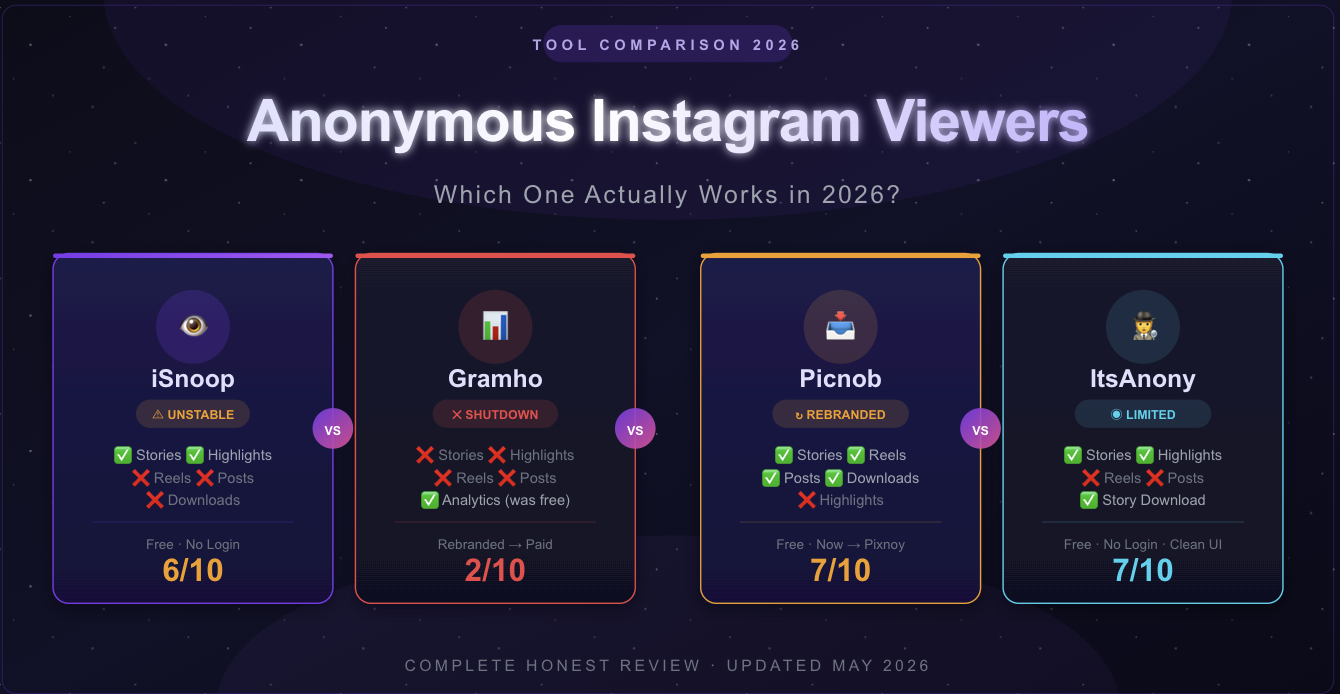
| Stories Viewer | ✅ | ❌ Gone | ✅ | ✅ |
| Highlights Viewer | ✅ | ❌ Gone | ❌ | ✅ |
| Reels Viewer | ❌ | ❌ | ✅ | ❌ |
| Posts Viewer | ❌ | ❌ | ✅ | ❌ |
| Download Option | ❌ | ❌ | ✅ | ✅ Stories only |
| Analytics | ❌ | ❌ Gone | ❌ | ❌ |
| No Login Required | ✅ | N/A | ✅ | ✅ |
| 2026 Status | ⚠️ Unstable | ❌ Dead | ⚠️ Rebranded | ⚠️ Limited |
| Operator Transparency | ❌ | ❌ | ❌ | ✅ |
| Free to Use | ✅ | ❌ Paid now | ✅ | ✅ |
The table tells a clear story. None of the four tools covers everything. iSnoop and ItsAnony are Stories-only. Picnob covers more content but cannot stay on one domain. Gramho is functionally dead. Every tool has a meaningful gap.
What a Complete Anonymous Instagram Viewer Actually Needs in 2026
Based on what users actually need from these tools in 2026, a genuinely complete solution requires five things:
Full content coverage — Stories, Highlights, Reels, and Posts. In 2026, any tool missing Reels is already missing the most-consumed content format on the platform.
Stable, consistent domain — No rebranding cycles, no broken bookmarks, no hunting for the “new” version every few months.
Download functionality — Not just viewing. Users need to save content across all formats, not just Stories.
No login requirement — The entire point of these tools is anonymous access. Any tool requiring Instagram credentials defeats its own purpose.
Transparent operation — Clear information about who runs the platform and how user data is handled. Four tools reviewed here — none fully deliver on this.
Which Tool Should You Use in 2026?
The honest answer depends on what you actually need:
For quick, casual Story viewing — ItsAnony is the most pleasant experience when it works. Just do not expect Reels or Posts.
For download-heavy use across content types — Picnob’s current Pixnoy version works, but track the domain carefully.
For anything Gramho used to do — There is no free equivalent. Accept that Gramho is gone and move to a working alternative.
For reliable, full-coverage anonymous Instagram viewing — None of the four tools reviewed here deliver it consistently. The best anonymous Instagram viewer for complete content access in 2026 is a separate tool entirely.
Frequently Asked Questions
Q: Which is better — iSnoop or ItsAnony? Both cover Stories and Highlights anonymously. ItsAnony has a cleaner interface and better mobile experience. iSnoop has more frequent downtime in 2026. For most users ItsAnony is the better choice between the two — but neither covers Reels or Posts.
Q: Is Gramho coming back? No reliable indication exists that the original Gramho is returning in any functional form. Its successor Gramhir is non-functional for Instagram viewing. Inflact, the paid commercial successor, does not offer the free anonymous viewing capabilities Gramho had.
Q: Is Picnob safe in 2026? The current Pixnoy version of Picnob works for public accounts and is relatively safe if you avoid entering personal information. The main risk is landing on fake clone sites using old Picnob domain names.
Q: Do any of these tools work on private Instagram accounts? No. None of the four tools — iSnoop, Gramho, Picnob, or ItsAnony — can access private Instagram accounts. No legitimate anonymous viewer tool can. Any tool claiming to view private profiles is either fraudulent or requires methods that violate Instagram’s terms of service in ways that carry real risk.
Q: Which tool is completely free in 2026? iSnoop, Picnob (Pixnoy), and ItsAnony remain free. Gramho’s successor Inflact now operates on a paid subscription model.
Final Verdict
iSnoop, Gramho, Picnob, and ItsAnony each had real strengths. In 2026, one is functionally dead, two are unreliable, and one works well within a narrow scope.
The honest conclusion: no single tool in this comparison delivers everything a user needs in 2026. Each one requires a workaround, a fallback, or an acceptance of significant limitations.